After finishing Pony Express, I found myself in an unusual place as a writer — I wanted to keep going, but the well of inspiration had run dry. I tried to force ideas, but nothing stuck. So I did what many writers do when the creative spark dims: I read.
I dove headfirst into a stack of Western-themed novels, hoping that something would stir me. I read the classics, the dime-store paperbacks, and the modern takes — all with wide-brimmed hats, dusty trails, and hard-eyed gunslingers. But instead of inspiration, I kept running into sameness. The characters started to blend together. The plots echoed one another. After a while, I joked to a friend that all these Westerns are the same story in different boots.
That’s when the idea hit me — or rather, when my friend nudged me toward it. He sent me a brief blurb about something called a “Hoodlum Wagon.” It was just a quirky little note, almost an offhand comment, but something about it stuck. I scribbled out a short scene based on that idea — nothing more than a sketch, really — but it was enough to shake loose the dust in my imagination.
And then I thought: Why not write the most generic Western I can? One that deliberately includes every trope and cliché I’ve been reading about? I decided to lean into it. To have some fun with it. And so, I began writing.
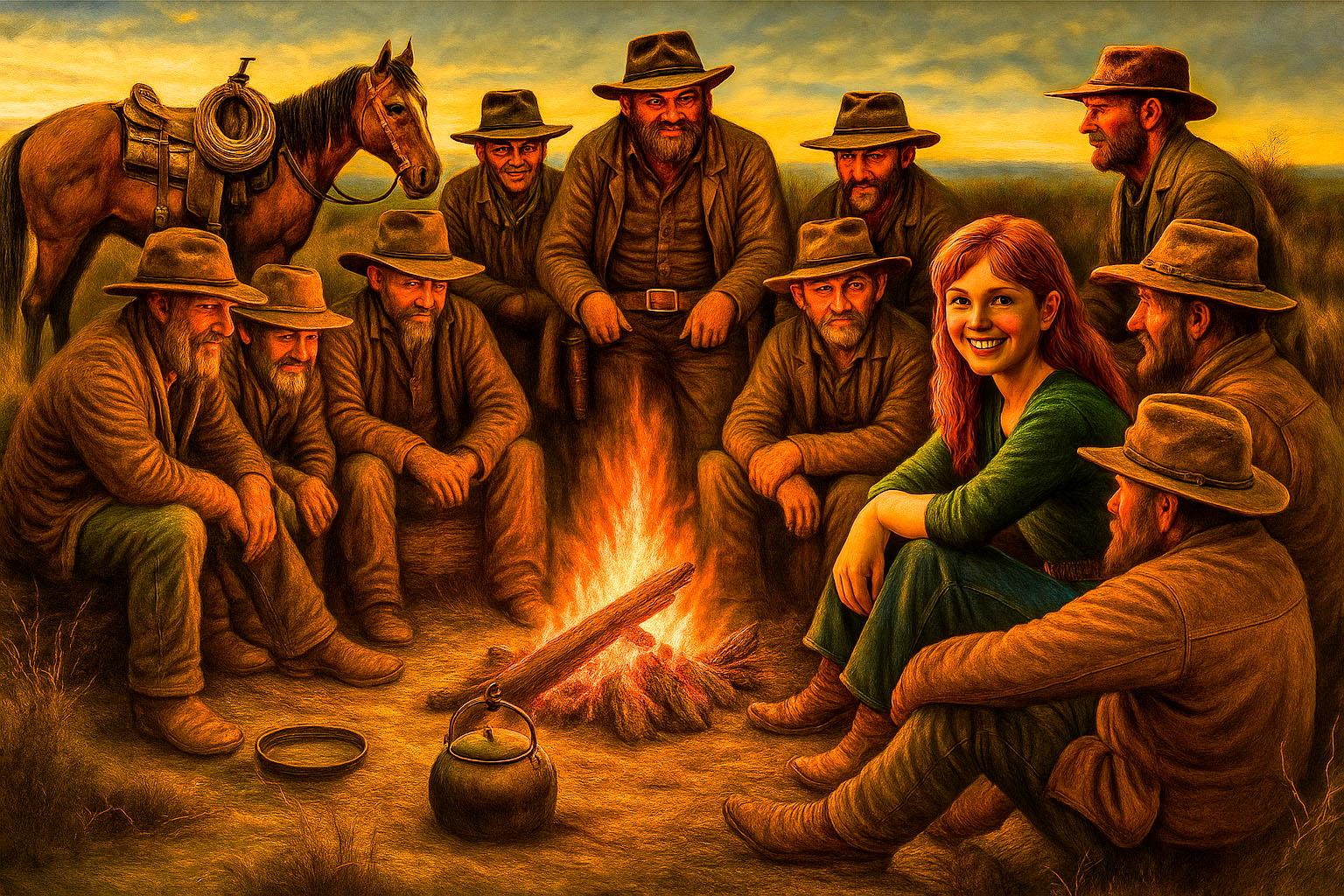
Of course, my Western needed a beautiful girl, the kind who turns heads but doesn’t put up with nonsense. There had to be an aimless country bumpkin, sincere and out of his depth, and a bully — someone you’re just waiting to see get what’s coming to him. There would be longhorn cattle, a trail drive, and yes — the obligatory stampede. A quick-draw gunfighter was a given. A gunfight at high noon? Naturally. I was building a Western from the bones of every Western I’d ever read.
What I didn’t expect was for the story to grow into something more.
Once I had a rough draft, I shared it with a thoughtful reader who took the story far more seriously than I had at first. She asked questions. Deep questions. About the characters, their motivations, their pasts — questions I hadn’t thought to ask myself. She challenged me to consider why they acted the way they did, what they feared, and what they wanted beyond the surface of the story.
That changed everything.
I rewrote. I layered in backstory. I gave my characters the weight of real choices. What started as a playful exercise became something richer, more meaningful. I dug into themes of identity, pride, hardship, and resilience. The clichés remained — but now they had roots.
In the end, the novel I set out to write as a generic, even ironic Western became something I’m truly proud of. Red-Haired Distraction is, without question, my best work to date — not because it’s full of gunfights and cattle, but because it’s full of real people, living through a time and place that shaped them.
Sometimes, inspiration doesn’t come in a lightning bolt. Sometimes, it comes when you lean into the ordinary — and take it seriously.